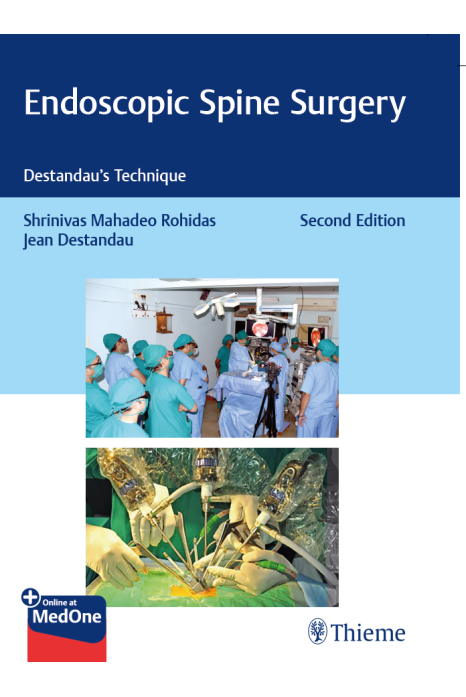
Endoscopic Spine Surgery: Destandau’s Technique, Second Edition, provides a detailed and critical analysis of Destandau’s endoscopic technique developed and popularized by eminent French neurosurgeon, Dr. Jean Destandau. He is also one of the authors of this book and has achieved a 90 to 95% success rate in 13,855 cases using this technique.
The benefits of this technique include achieving higher mobility and wider reach of spinal defects despite minimal invasion, better management of underlying compressive pathologies, quicker patient recovery, and less blood loss, without compromising existing spinal stability.
The book provides comprehensive information on Destandau’s technique and will help spine surgeons negotiate the steep learning curve required to master it with ease. Through an analytical approach and explanation of tricks and pitfalls, the detailed step-by-step discussion of every step of the surgery helps surgeons train to perform costeffective surgeries, which will help promote the practice of this endoscopic spine surgery technique.
The chapters of this book cover a wide range of topics that explain the use of Destandau’s technique from the lumbar to the cervical spine in the management of various types of pathologies including disc herniation, stenosis, and intradural space-occupying lesions. In addition, they also explain the technical tricks and pitfalls and the prevention of complications.
Key features of the book:
- Documents cases and their surgical results in a clear, systematic step-by-step manner.
- Covers the use of an ultrasonic bone dissector rasp-knife in Destandau’s technique.
- Includes both basic and advanced aspects of the technique extensively, thereby making it useful for young surgeons to start with this technique as well as for experienced surgeons to expand their existing indications to tackle complicated cases like posterior and cervical pathologies and intradural extramedullary SOL.
New to this edition!
- A separate chapter on the use of the 3D endoscope with Destandau’s technique, which is only possible with this technique and not with any other technique.
- A new dedicated chapter on synovial cyst treatment using Destandau’s technique.
- Razor-sharp figures obtained with the 3D endoscope, offering unmatched visual precision and clarity.
Online at MedOne
Access your complimentary online version directly from https://medone.thieme.com by using the unique scratch code in the front of this book.
Publisher's Note: Products purchased from Third Party sellers are not guaranteed by the publisher for quality, authenticity, or access to any online entitlements included with the product.
Contents
Preface
Acknowledgments
1. Introduction
2. Philosophy of Minimalism in Spine Surgery with Endospine—The Mobile Tubular Retractor
3. Basics of Destandau’s Technique
4. Localization of Disc Space
5. Endoscopic Lumbar Discectomy—Interlaminar Approach
6. Endoscopic Lumbar Canal Decompression—Bilateral Decompression Using Unilateral Approach
7. Endoscopic Lumbar Discectomy—Transforaminal Approach
8. Role of Endospine in Early Lumbar Degenerative Spondylolisthesis
9. Endoscopic Excision of Synovial Cysts (Juxta-Facetal Cysts): Destandau’s Technique—Interlaminar Approach
10. Posterior Cervical Endoscopic Discectomy
11. Endoscopic Anterior Cervical Discectomy and Cord Decompression—Destandau’s Technique
12. Endoscopic Removal of Intradural Extramedullary Space-Occupying Lesion
13. Ultrasonic Bone Dissectors in Minimally Invasive Spine Surgery
14. Tricks and Pitfalls to Overcome Steep Learning Curve in MISS and Avoid Complications in MISS
15. 3D Endoscope in Minimally Invasive Spine Surgery—Destandau’s Technique
16. The Future of Destandau’s Technique—Minimally Invasive Spine Surgery without Instrumentation: Role of Surgeon, Patient, Hospital and Companies
Index